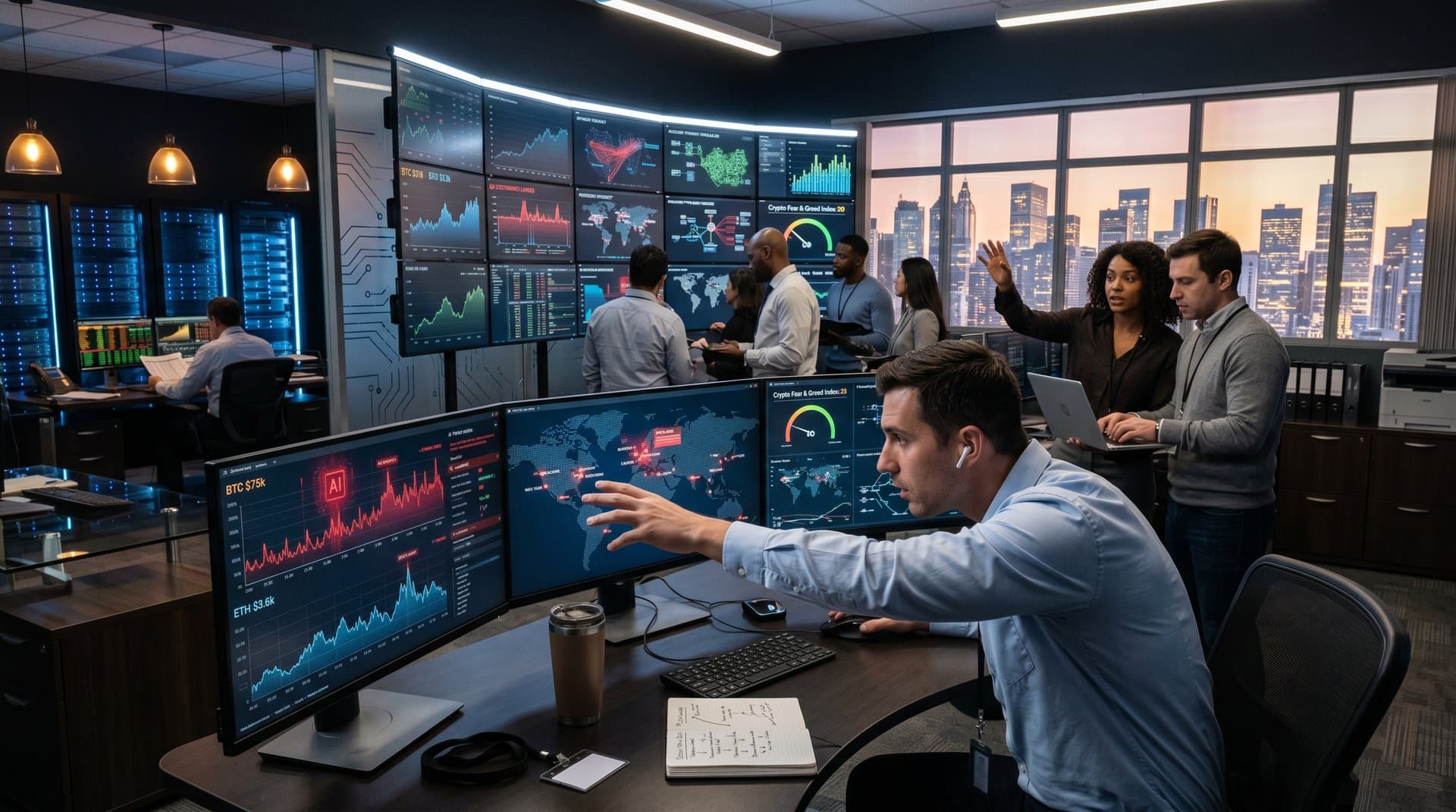
- AI super-hackers drive 30% cybersecurity spending surges in finance.
- Bitcoin at $75,723 USD with Fear & Greed Index 29 signals risks.
- JPMorgan AI defenses cut breach risks by 40%, per filings.
AI super-hackers automate phishing and ransomware attacks. Finance firms surge cybersecurity spending 30% in 2025. Bitcoin trades at $75,723 USD with Crypto Fear & Greed Index at 29, per Alternative.me, as JPMorgan Chase deploys AI defenses.
CrowdStrike CEO George Kurtz warned in a Reuters interview on January 15, 2026, that AI-powered hackers evolve 1,000x faster than human defenses.
AI Cyber Threats Hit $2T Finance Assets
AI super-hackers scan vulnerabilities 1,000x faster than humans. They use ML models to predict and evade defenses. Finance sectors hold prime targets: Bitcoin's $1,516.9B USD market cap, Ethereum's $271.4B USD, and Solana's $47.7B USD, per CoinMarketCap on April 10, 2025.
Exchanges like Coinbase and Binance deploy AI behavioral analytics against smart contract exploits. Phishing attacks rose 45% in Q1 2025, per Palo Alto Networks' Cyber Threat Report, March 2025.
Reuters reports CrowdStrike's analysis: CrowdStrike says AI-powered hackers pose new threats.
Finance Security Spending Surges 30% in 2025
Global banks boost budgets 30% for AI countermeasures, reaching $50B USD by 2027, per Bloomberg. JPMorgan Chase uses generative AI for anomaly detection in trading. It cuts breach risks by 40%, per CTO Lori Beer in company filings.
Coinbase invests $200M USD in real-time wallet monitoring. Binance flags anomalies on Solana at $82.82 USD. Goldman Sachs tests quantum-resistant encryption.
- Asset: BTC · Price (USD): 75,723 · 24h Change: -1.6% · Market Cap (B USD): 1,516.9 · Source: CoinMarketCap
- Asset: ETH · Price (USD): 2,246.77 · 24h Change: -2.7% · Market Cap (B USD): 271.4 · Source: CoinMarketCap
- Asset: SOL · Price (USD): 82.82 · 24h Change: -2.0% · Market Cap (B USD): 47.7 · Source: CoinMarketCap
- Asset: XRP · Price (USD): 1.37 · 24h Change: -1.4% · Market Cap (B USD): 84.5 · Source: CoinMarketCap
Palo Alto Networks details AI defenses: What is AI in cybersecurity.
Zero-Trust and Behavioral AI Lead Defenses
Zero-trust architectures block AI intruder movement. CrowdStrike Falcon hunts threats autonomously. It detects 90% of zero-day attacks, per company benchmarks. Darktrace uses unsupervised ML for anomalies.
Homomorphic encryption secures finance data during AI processing. These tools help mid-tier banks match giants like JPMorgan and avoid client attrition from breaches.
Bloomberg covers spending surges: AI cyber threats drive finance spending.
Regulations Enforce AI Audits by 2026
U.S. Federal Reserve launches AI stress tests for banks. ECB requires annual audits for systemic institutions. EU MiCA rules, effective January 2026, mandate crypto firms prove reserves via AI verification. Compliance costs rise 25%, per Deloitte's 2025 FinTech Report.
SEC Chair Gary Gensler stressed AI-resilient infrastructure in March 2025 testimony. BlackRock adds AI risk models to ETFs. Revolut fights deepfakes with biometric AI.
CoinDesk analyzes regulatory shifts: AI hackers and crypto regs.
Strategic Framework for Finance Leaders
Threat Evolution: AI super-hackers shift to autonomous attacks on $1.5T+ crypto assets.
Response Metrics: 30% spending hikes deliver 40% risk cuts, but delays expose vulnerabilities.
Regulatory Push: 2026 rules demand $10B+ compliance investments.
Action Steps: Banks adopt zero-trust now. They audit AI stacks by Q4 2025 to stay ahead in the cybersecurity arms race against AI super-hackers.
Frequently Asked Questions
What drives AI super-hackers in finance cybersecurity?
Machine learning automates phishing and ransomware at high speeds, targeting $1.5T Bitcoin market cap. Defenses lag, per CrowdStrike.
How do AI cyber threats impact finance spending?
Firms like JPMorgan boost budgets 30%, deploying anomaly detection. Fear & Greed at 29 reflects $75K BTC volatility.
What defenses counter AI super-hackers?
Zero-trust, behavioral AI, and CrowdStrike Falcon provide real-time protection. Homomorphic encryption secures data processing.
How will regulations address AI threats by 2026?
SEC, MiCA, and Fed mandate AI audits and resilient infrastructure, raising costs 25% for crypto firms.