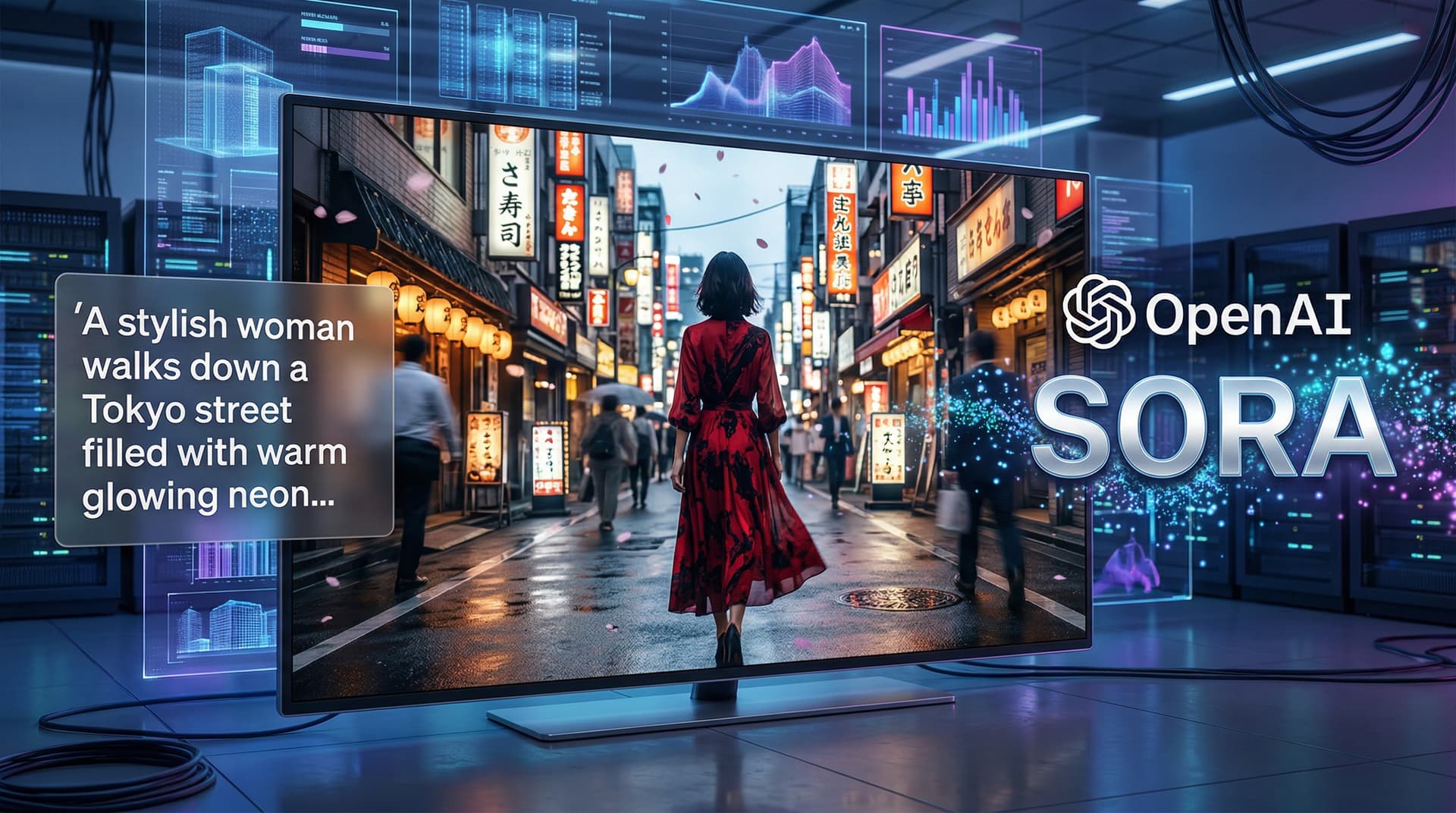
On February 15, 2024, OpenAI dropped a bombshell in the AI world with the announcement of Sora, a new text-to-video generation model that pushes the boundaries of what's possible in synthetic media. As a senior tech journalist at HWR News, I've covered the rapid evolution of generative AI from image tools like DALL-E to language models like GPT-4. Sora represents the next frontier: turning words into dynamic, high-fidelity videos. This isn't just an incremental update; it's a potential game-changer for filmmakers, marketers, educators, and anyone who creates visual content.
Understanding Sora's Core Capabilities
At its heart, Sora is designed to understand and simulate the physical world in motion. Users input a text prompt—something as simple as "A stylish woman walks down a Tokyo street filled with warm glowing neon and vividly animated city signage"—and Sora generates a video clip up to 60 seconds long at 1080p resolution. Unlike previous video AIs limited to short bursts or low quality, Sora produces complex scenes with multiple characters, specific motions, and accurate physics.
OpenAI shared several stunning demos on their blog and Twitter. One shows a wolf trekking through a snowy mountain landscape, its fur rippling realistically in the wind. Another depicts an urban aerial shot over a fantastical cityscape, seamlessly blending photorealism with imaginative elements. There's even a whimsical clip of a pencil sketching a cartoon mouse that springs to life on the page. These aren't choppy animations; they're fluid, coherent narratives that rival professionally produced footage.
Sora excels in maintaining consistency across frames—characters don't morph unnaturally, backgrounds stay stable, and lighting evolves naturally. It can also handle extensions: start with a short clip and extend it while preserving style and continuity. Image-to-video is supported too, animating still photos into motion.
The Technology Behind the Magic
While OpenAI hasn't disclosed full technical details (citing competitive reasons), Sora builds on diffusion models, similar to Stable Diffusion but scaled massively for video. It's trained on vast datasets of internet videos and licensed content, learning spatiotemporal patches—3D chunks of visual data that capture movement over time.
A key innovation is the "world simulator" concept. Sora doesn't just predict the next frame; it models the underlying physics, geometry, and causality of scenes. This allows for emergent behaviors, like a balloon floating realistically or waves crashing with proper foam dynamics. Sam Altman, OpenAI's CEO, tweeted: "We are blown away by what it can do already, and we think it has a lot of room to get much better. It’s currently an early preview, and we will be working hard to make it safe and broadly available."
Compute-wise, Sora likely required enormous resources, trained on GPU clusters akin to those for GPT-4. Inference is optimized for accessibility, though currently limited to red-teaming partners like filmmakers and visual artists for feedback.
Transformative Applications Across Industries
The implications are profound. In Hollywood, Sora could democratize visual effects, allowing indie creators to prototype scenes without massive budgets. Marketing teams might generate personalized ads on the fly. Educators could simulate historical events or scientific phenomena vividly. E-commerce? Custom product videos from descriptions.
Imagine a newsroom using Sora for quick visualizations of breaking stories—a drone shot of a disaster site before real footage arrives. Or social media influencers churning out endless variations of viral content. As Altman noted, it's a tool to "help people create compelling videoclips from simple text instructions."
Navigating Ethical and Safety Challenges
With great power comes great responsibility. OpenAI is acutely aware of risks like deepfakes and misinformation. Sora videos include visible watermarks, and metadata traces origins. The model is restricted from generating certain content, such as real people or violence, though enforcement relies on classifiers.
Broader concerns loom: job displacement for VFX artists and stock footage creators? Floods of AI slop degrading online video quality? Regulators are watching; the EU's AI Act and U.S. executive orders on AI safety emphasize transparency. OpenAI's phased rollout—starting with trusted testers—mitigates this, gathering red-team insights on jailbreaks and biases.
Critics like those from the Center for AI Safety argue for more openness, but OpenAI prioritizes safety over speed, learning from past rushes with DALL-E.
Competitive Landscape and OpenAI's Edge
Sora enters a crowded field. Runway's Gen-2 produces 16-second clips; Pika Labs focuses on stylized shorts; Stability AI's Stable Video Diffusion handles 25 frames. Google's VideoPoet and Meta's Make-A-Video lag in realism. What sets Sora apart? Superior length, quality, and world understanding, powered by OpenAI's data moat and scaling laws.
Microsoft's investment gives Azure cloud muscle, potentially integrating Sora into Bing or Office for video tools. Rivals like Anthropic (focused on safety) or xAI (Elon Musk's venture) may accelerate their video efforts.
Looking Ahead: The Road to Broad Availability
OpenAI plans iterative improvements: longer videos, 4K resolution, audio integration. Full public access might come via ChatGPT Plus or API later in 2024, with pricing TBD. Expect plugins for Adobe Premiere or Final Cut Pro.
As we stand on February 20, 2024, Sora signals AI's march toward multimodal mastery—text, image, now video. It echoes the iPhone's impact on photography: augmentation, not replacement. Creators will adapt, blending human ingenuity with AI efficiency.
Yet, this tech demands vigilance. OpenAI's commitment to "safe AGI" will be tested. For now, Sora dazzles, hinting at a future where imagination is the only limit.
Word count: 912