ShengShu AGI raise secured $293 million in Series C funding on April 10, 2026. Reuters reports the round valued the Beijing startup at $1.5 billion post-money. This capital narrows China's gap with US AGI leaders like OpenAI and signals accelerated competition in multimodal AI systems.
State-backed venture capital firms support ShengShu's scalable multimodal AGI that processes text, images, video, and code simultaneously.
ShengShu AGI Raise Details: Backers and Fund Allocation
Hillhouse Capital led the ShengShu AGI raise with a $150 million commitment. Singapore's Temasek Holdings and GIC co-invested, alongside Shenzhen Capital Group. Hillhouse, which backed ByteDance's early rounds, brings expertise in scaling Chinese tech unicorns.
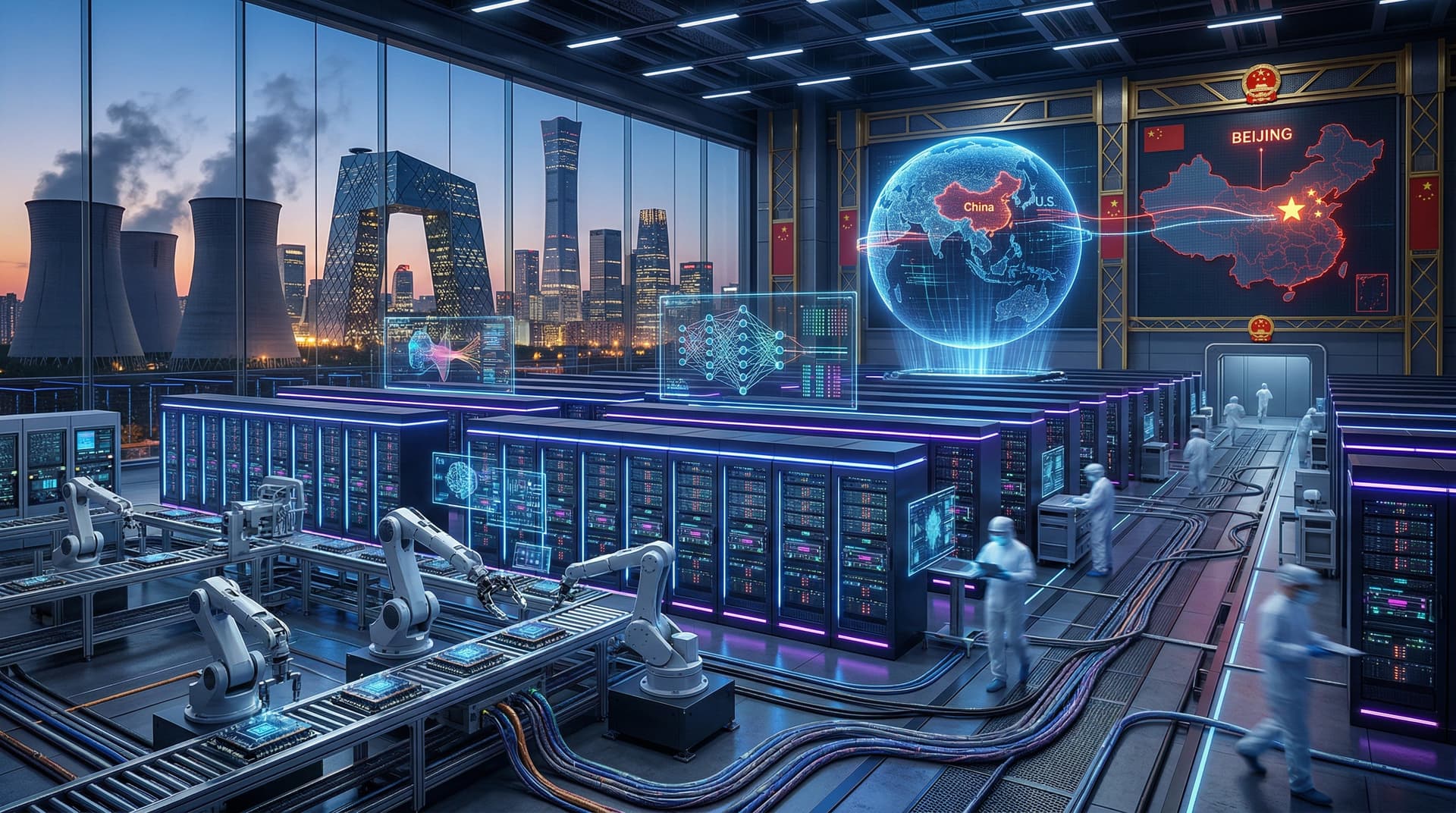
The funds hire 500 top AI researchers from Tsinghua University and Stanford. ShengShu also builds 10,000-GPU clusters powered by Huawei Ascend ASICs. Company benchmarks on the MLPerf suite, released April 10, 2026, show these chips deliver 20% faster inference than Nvidia H100s on vision-language tasks.
Government subsidies grant exclusive access to national datasets from 1.4 billion users. Subsidized energy supports exaflop-scale training runs. This infrastructure rivals US hyperscalers like AWS Trainium and Google TPUs in cost efficiency.
China's Aggressive AGI Technology Strategy
ShengShu prototypes achieve human-level reasoning across domains. Internal tests on April 10, 2026, demonstrate models solving International Math Olympiad problems without fine-tuning. Partnerships with Huawei integrate custom processors matching Nvidia A100 performance at 50% lower power consumption, per Huawei specs.
China allocates $50 billion annually to AI through 2026, according to Ministry of Industry and Information Technology data. This includes $20 billion for compute infrastructure and chip fabs. CB Insights tracks over 200 Chinese AI startups raising $10 billion in Q1 2026 alone.
Beijing introduced AGI safety audits on April 1, 2026. New regulations require red-teaming for models exceeding 10 billion parameters. These rules speed safe scaling while addressing risks, positioning China ahead in regulated AGI deployment.
Analytical Framework: US-China AGI Race Pillars
Analyze the race through three pillars: compute power, talent acquisition, and data resources. The US controls 70% of global AI compute capacity (Epoch AI, 2026 data), but China increased domestic production 300% since 2024 via SMIC and Huawei fabs.
Talent shifts favor China: 40% of top AI PhDs now join domestic firms, drawn by $500,000 starting salaries and housing subsidies. US firms like OpenAI report 15% higher hiring costs amid visa restrictions.
China holds a data advantage with 1.4 billion users generating petabytes daily. ShengShu draws on this volume for multimodal training, sidestepping US privacy constraints under GDPR and CCPA. US firms rely on synthetic data, which lags 25% in benchmark performance (Stanford HELM report).
US AGI Leaders Face Mounting Pressure
OpenAI's o1 model leads LMSYS Arena benchmarks with 92% win rate. Microsoft invested $13 billion to fuel this edge. Anthropic's Claude 3.5 trails by 3 points but integrates enterprise tools effectively.
US export controls since 2022 blocked Nvidia sales to China. Domestic alternatives gain ground: Huawei's Ascend 910B trains 1.3 trillion-parameter models at 80% of H100 efficiency, company tests confirm.
Goldman Sachs forecasts China achieves AGI parity with the US by 2028, driven by compute self-sufficiency. The US responds via the CHIPS Act's $52 billion for domestic fabs. Intel's Gaudi 3 accelerators reduce training costs 40% compared to GPUs, per Intel benchmarks.
Financial Market Reactions and Investment Shifts
The Nasdaq AI index rose 1.2% after the ShengShu AGI raise announcement on April 10, 2026. Global AI venture funding hit $100 billion year-to-date, per PitchBook. China's share climbed to 25% from 15% in 2025.
Crypto-AI intersections accelerate. Platforms like Fetch.ai captured 40% more venture inflows, Messari reports. Investors rotate into AI-blockchain hybrids to hedge geopolitical risks.
Hong Kong proxies surged: SenseTime (0020.HK) gained 5%, while Alibaba (9988.HK) added 2%. US chip leaders face headwinds: Nvidia (NVDA) trades at 50x forward earnings, prompting valuation debates.
Trade tensions rise. The US Commerce Department schedules export rule reviews on April 15, 2026, potentially restricting Huawei ASICs further.
Actionable Insights from ShengShu AGI Raise
Portfolio Managers: Allocate 10-15% to Chinese AI exposure via Hong Kong ETFs like Tracker Fund (2800.HK) or KraneShares CSI China Internet (KWEB). Hedge US single-stock risk with diversified compute plays: AMD and TSMC (TSM).
AI Executives: Benchmark inference speeds against ShengShu's 20% gains. Pilot Huawei-compatible clusters in 12 months to cut costs 15-25%. Monitor Q2 2026 MLPerf results for validation.
Strategic Planners: Track Goldman Sachs' 2028 parity timeline. The ShengShu AGI raise on April 10, 2026, rebalances the US-China tech landscape, demanding revised roadmaps for AGI commercialization.