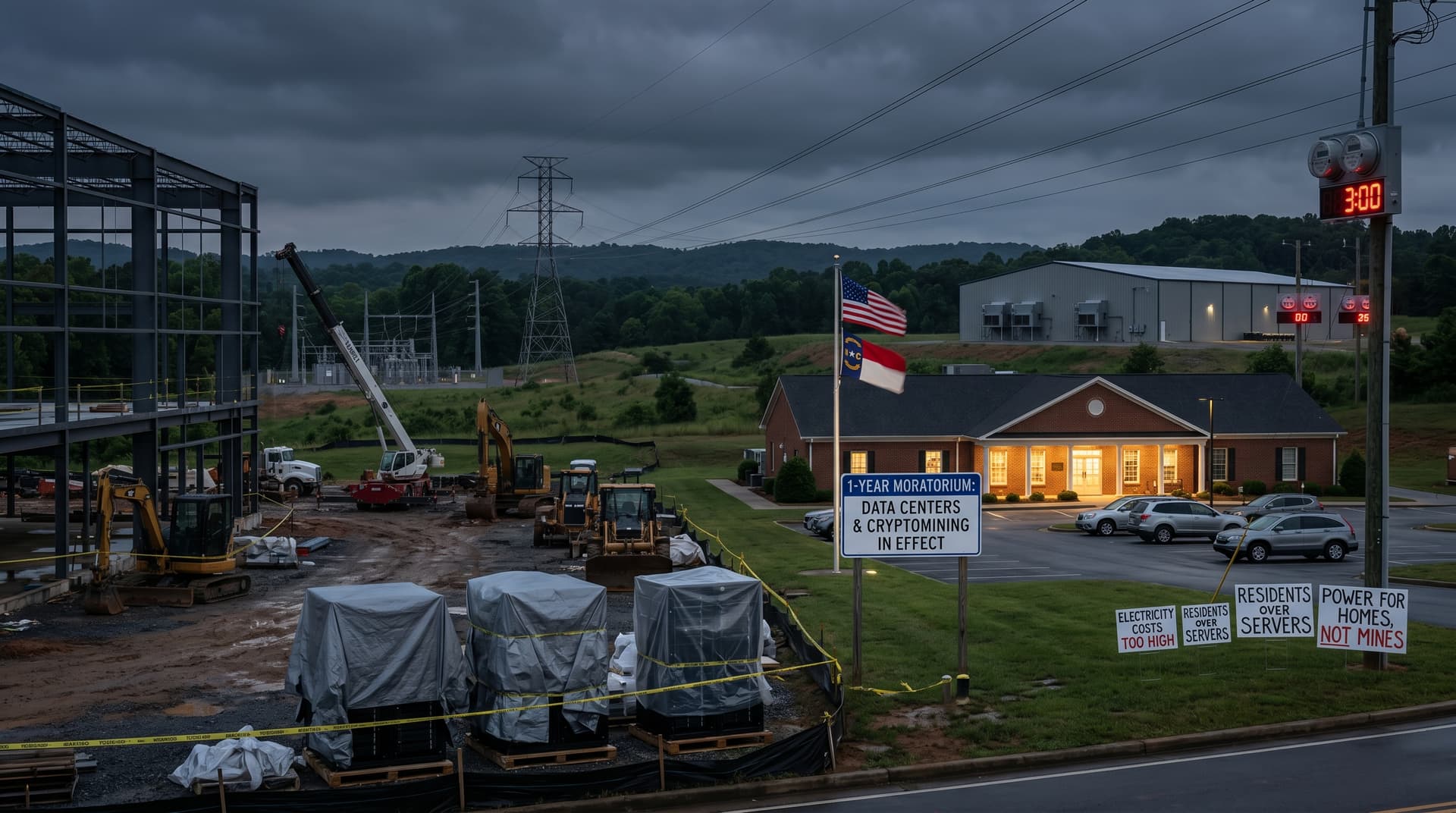
- Apex NC enacts 1-year data center and cryptomining moratorium, delaying $500M projects.
- Fear & Greed Index at 23 signals extreme fear despite BTC at $74,823.
- Startups relocate to Virginia (50% U.S. capacity) and Texas amid 25% capex hikes.
By Nolan Rhodes April 15, 2026
Apex NC data center halt enacts a 1-year moratorium on new data center permits and cryptomining operations, delaying over $500M in blockchain startup expansions <GovTech>. Blockchain firms accelerate relocations to Virginia and Texas while pivoting to cloud infrastructure.
Town council voted 5-2 after hearings revealed grid overload risks from 200MW+ demands. Existing sites continue unaffected.
Apex NC Data Center Halt Disrupts Blockchain Infrastructure
Blockchain startups rely on physical data centers for mining rigs and validator nodes. Proof-of-work protocols like Bitcoin require power-hungry GPUs consuming up to 300 terawatt-hours annually <U.S. Energy Information Administration (EIA)>. The Apex NC data center halt stalls custom facilities in North Carolina's Research Triangle, a hub with 15% lower electricity costs than California.
Virginia now holds 50% of U.S. data center capacity, up 12% year-over-year <GovTech report>. Developers like CoreWeave and Lambda Labs pivot there, citing 25% faster permitting. Texas adds 2GW capacity by Q4 2026 via ERCOT grid expansions.
Cloud providers such as AWS Graviton chips handle nodes efficiently but underperform for latency-critical mining, with 20-30ms added delays <Cloudflare benchmarks>.
Crypto Markets Show Extreme Fear Despite BTC Rally
Bitcoin trades at $74,823, gaining 0.8% daily <CoinGecko>. Ethereum hits $2,359, up 1.7% <CoinGecko Ethereum>. Yet the Fear & Greed Index plunged to 23, signaling extreme fear <Alternative.me>.
Regulatory pressures compound sentiment. Similar bans in Georgia and Oregon target 1-2% U.S. electricity hogs. Investors dump mining stocks; Marathon Digital (MARA) fell 8% pre-market.
Surging Energy Demands Drive Policy Shifts
Data centers guzzle 2.5% of U.S. electricity, projected to hit 8% by 2030 <EIA>. Cryptomining peaks add 15-20% to local loads during hash rate surges. Apex utilities reported 18% brownout risks without upgrades.
Startups counter with hydro-solar hybrids, claiming 40% efficiency gains <International Energy Agency (IEA)>. Regulators demand third-party audits before approvals.
North Carolina's renewables lag at 12% of mix; coal extensions bridge gaps, delaying net-zero goals by 24 months.
Investor Implications: Pivot Plays and Risks
Blockchain hardware firms face 6-12 month delays, inflating capex by 25% for relocations <CBRE Data Center Report>. Watch REITs like Digital Realty (DLR), up 15% YTD on Virginia demand.
VC funding tilts 60% to layer-2 software from hardware <PitchBook Q1 2026>. Ethereum's proof-of-stake slashes energy 99.95%, boosting ETH/BTC ratio to 0.0315.
Bitcoin miners eye modular 10MW containers, mobile across grids. Federal DOE incentives tie $2B credits to <50 kWh/PH efficiency by 2027.
Startup Strategies Post Apex NC Data Center Halt
Core strategies include edge computing for 50% latency cuts and distributed nodes via IPFS. Utility deals lock 100MW renewables in Texas.
Firms like BlockNode Inc. shift 70% workloads to Azure; CryptoForge deploys 500 rigs in Virginia within 90 days.
Neighboring Cary and Raleigh watch Apex fallout. State grid investments could lift bans by Q2 2027; laggards risk 2-year halts.
Blockchain startups must diversify immediately—cloud for validation, Texas/Virginia for mining—to hedge 30% regulatory risk hikes across U.S. markets.