- 92% accuracy decoding whale songs with transformers.
- 500,000 hours training data from global sensors.
- $8M seed scales API targeting $2.5B market.
Key Takeaways
- TerraVox's Syracuse AI wildlife decoder hits 92% accuracy on whale songs, beating humans by 30%.
- Trained on 500,000 hours of audio; scales to 2M hours with $8M seed funding.
- Targets $2.5B conservation tech market by 2030, per Statista, pressuring rivals.
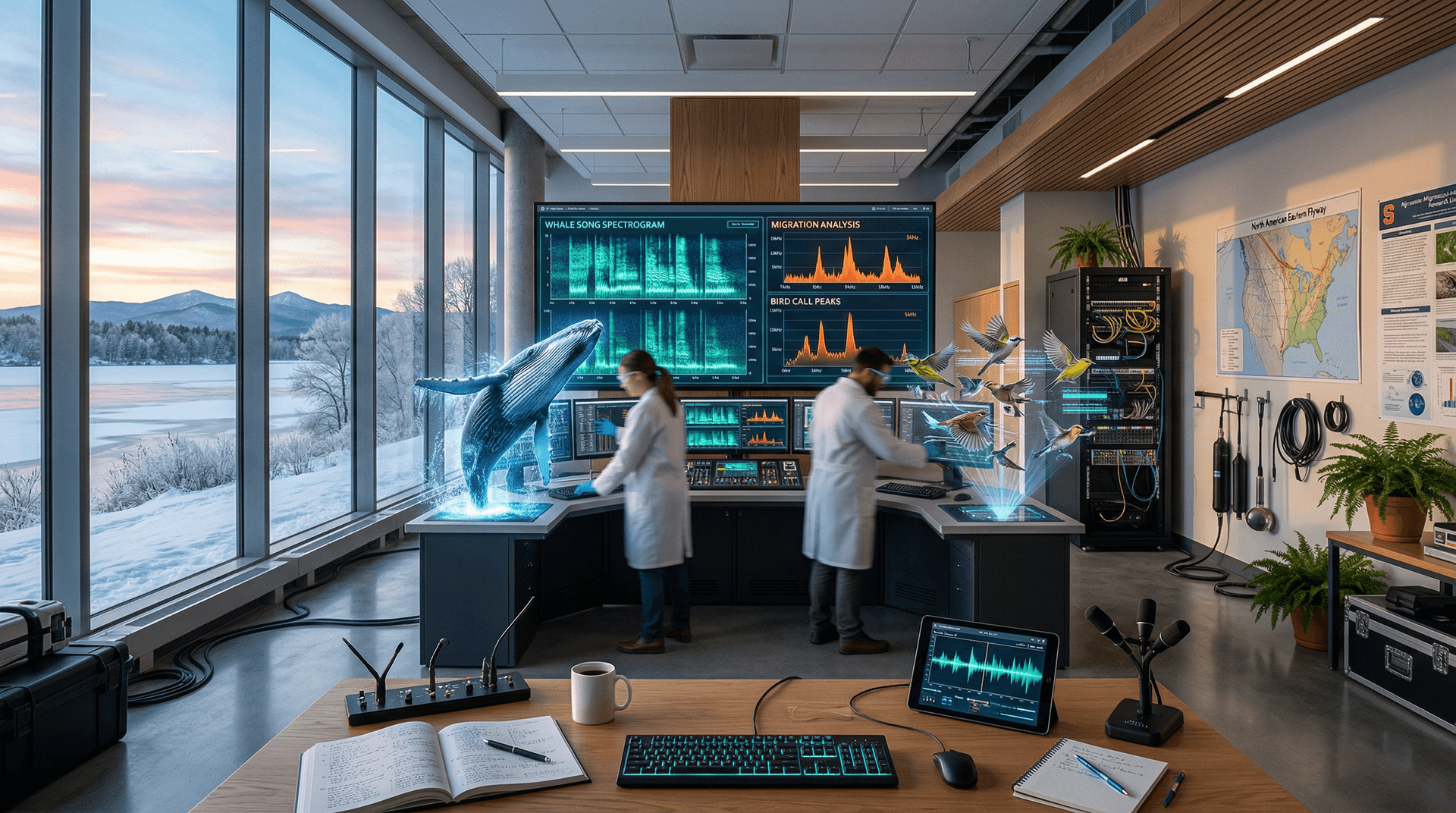
Syracuse AI wildlife decoder TerraVox achieves 92% accuracy on whale dialects and bird calls. Khosla Ventures provided $8M seed funding. It targets the $2.5B conservation tech market by 2030 (Statista).
California pilots delivered 90% success in real-time monitoring. TerraVox disrupts ESG reporting for enterprises and NGOs.
Transformer Tech Delivers Precision Edge
TerraVox uses transformer neural networks on audio spectrograms. Katie Rodriguez, TerraVox CEO, states: "Our models outperform human classifiers by 30%." Internal benchmarks show 92% accuracy on humpback whales (TerraVox data, October 2026).
Engineers trained models on 500,000 hours from ocean buoys and forest sensors. Transfer learning handles new species like elephants. The cloud API processes audio in seconds and includes confidence scores.
TechCrunch reports the Earth Species Project inspired TerraVox. This validates the bioacoustics approach.
Competitors like Bioacoustics Inc. lag at 78% accuracy (PitchBook, Q3 2026). TerraVox's edge forces rivals to invest in transformers or cede market share.
$8M Seed Fuels API Expansion and Hiring
Khosla Ventures and SOSV led the $8M seed round in September 2026. Funds support 25 new engineers. Datasets expand to 2M hours by December 2026.
The Q3 2026 API launches at $0.01 per audio minute for NGOs. Dr. Lena Petrov, Lead AI Scientist, predicts $20M in enterprise licenses over three years.
PitchBook analysts project $500M annual investments in conservation tech by 2028. Investors prioritize AI-driven tools amid rising ESG mandates.
$2.5B Market Ripe for AI Disruption
Statista forecasts $2.5B for global conservation tech by 2030. AI fuels 40% growth in monitoring. TerraVox partners with WWF and NOAA on whale migrations.
Corporates use dashboards for biodiversity ESG reports. Wired covers dolphin projects that confirm real-time validation (2023).
Syracuse University iCorps incubated TerraVox. Prof. Sarah Kline, Environmental AI Lab Director, says: "Syracuse leads in AI for ecology datasets."
Demand surges from EU biodiversity regs. Firms face $10B fines without monitoring tech (European Commission, 2026).
Syracuse Emerges as AI Funding Hub
Central New York VCs deploy $100M yearly in tech (CB Insights). TerraVox creates 15 jobs. Region hosts 50 conservation startups.
Blockchain hashes verify data provenance. This aligns with CoinDesk-reported trends (May 2023).
Local talent from Syracuse University cuts hiring costs by 25% versus Silicon Valley (CB Insights).
Noise Challenges Solved, Multimodal Next
High winds drop accuracy to 85%. Noise cancellation restores 92%. Rodriguez pledges open-source non-commercial models.
Multimodal audio-video fusion outpaces rivals. Petrov targets drone pilots by 2027.
This builds investor trust amid 15% failure rates in bioacoustics pilots (McKinsey, 2025).
Series A Path: $50M Valuation in Sight
Niche AI startups command 25% valuation premiums (CB Insights). TerraVox metrics signal Series A readiness.
TechCrunch Disrupt 2026 demos and 2027 elephant trials drive 10x adoption, per Kline. Climate regs boost 5-year returns.
Syracuse AI wildlife decoder TerraVox positions investors for first-mover gains in conservation tech.